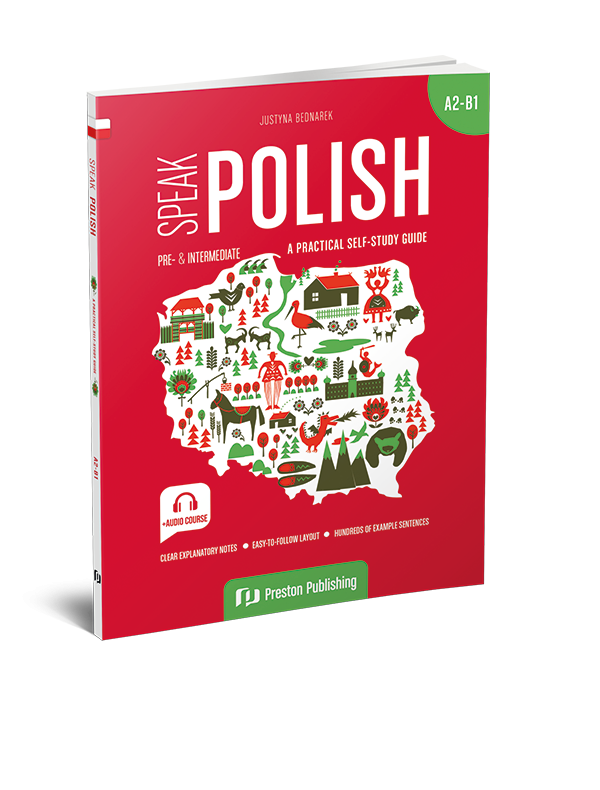
Speak Polish. A practical self-study guide. Part 2. A2-B1
Do you want to speak Polish and understand what Polish people say? With this new way of practising the language you will have the chance to learn and communicate in Polish effectively.
Speak Polish. A Practical Self-study Guide is a new manual for students of Polish as a foreign language. The course starts with the concepts at pre-intermediate level and takes the student on a journey towards more advanced grammar.
Each chapter contains over 30 sentences which need to be translated and then compared to the correct answer provided on the right-hand side. This way, you have a chance to understand and practise a particular grammar point using everyday sentences. You can also correct your mistakes and review the vocabulary used in the sentences. The explanatory notes provided next to the sentences clearly present the theory and point out common mistakes made by learners. The book comes with downloadable mp3 recordings with the complete audio course in two versions: English-Polish to practise speaking and Polish only to practise pronunciation and listening comprehension.
Gramatyka języka polskiego wydaje Ci się niemożliwa do opanowania, a brzmiące w szczebrzeskiej trzcinie chrząszcze nie dają Ci spać? Speak Polish. A practical self-study guide. Part 2 to propozycja dla Ciebie!
W książce znajdziesz wiele przydatnych zdań w języku polskim na poziomie średnio zaawansowanym, które będziesz mógł wykorzystać w codziennych sytuacjach, a także przystępne informacje na temat polskiej gramatyki przedstawione w języku angielskim. Możliwy do pobrania kurs audio (MP3) ze zdaniami nagranymi przez natywnego lektora ułatwi Ci natomiast opanowanie największych zawiłości wymowy.
Is this book right for you?
| Yes, if… | No, if… |
|---|---|
| You already know the basics of Polish and want to move on to pre-intermediate and intermediate grammar. | You are a complete beginner and need to start with the most basic Polish structures. |
| You want to practise Polish grammar by translating useful everyday sentences rather than memorising rules alone. | You are looking only for vocabulary lists or a traditional Polish phrasebook. |
| You want clear grammar explanations in English and practical notes about common mistakes. | You prefer all grammar explanations and instructions to be provided exclusively in Polish. |
| You want to identify your mistakes by comparing your translations with the correct Polish sentences. | You do not want to practise actively by translating and constructing complete sentences. |
| You want to practise speaking, pronunciation and listening comprehension with recordings by a native Polish speaker. | You are looking for advanced materials aimed exclusively at highly proficient learners. |
FAQ
1. Who is Speak Polish. A Practical Self-study Guide. Part 2 for?
The book is designed for learners who already know the basics of Polish and are ready to work with pre-intermediate and intermediate grammar structures.
2. How does the learning method work?
Each chapter contains more than 30 sentences to translate into Polish. You prepare your own translation and then compare it with the correct answer provided on the right-hand side, helping you understand and practise grammar in context.
3. Are the grammar explanations provided in English?
Yes. The explanatory notes are written in English, making more demanding Polish grammar easier to understand. They also draw attention to common mistakes made by learners.
4. Does the book teach practical everyday Polish?
Yes. The grammar structures are practised through useful sentences that can be applied in everyday situations, allowing you to develop grammar and vocabulary at the same time.
5. How does the book help me correct my mistakes?
After translating each sentence, you can immediately compare your version with the correct Polish answer. Additional notes explain important grammar points and highlight errors that learners commonly make.
6. What does the downloadable audio course include?
The MP3 course is available in two versions: English-Polish recordings for speaking practice and Polish-only recordings for practising pronunciation and listening comprehension.
7. Is this book suitable for independent study?
Yes. The translation-based exercises, correct answers, English grammar explanations and downloadable audio course make it particularly suitable for systematic self-study.
1. The conjunctions
Spójniki
2. The comparative and superlative of adverbs
Stopień wyższy i najwyższy przysłówków
3. Very, a lot of, many, much
Bardzo, dużo
4. Accusative, instrumental & genitive
Biernik, narzędnik i dopełniacz
5. Questions (instrumental, accusative, genitive)
Pytania (narzędnik, biernik, dopełniacz)
6. Numbers 200-1999
Liczby 200-1999
7. Locative 1
Miejscownik 1
8. Locative 2
Miejscownik 2
9. Months
Miesiące
10. In January, in February
W styczniu, w lutym
11. The ordinal numbers (first, second, etc.)
Liczby porządkowe (pierwszy, drugi itd.)
12. Review 1
Powtórka 1
13. In what year…?
W którym roku…?
14. The plural of masc.pers. nouns
Liczba mnoga rzeczowników męskoosobowych
15. The plural of masc.pers. adjectives
Liczba mnoga przymiotników męskoosobowych
16. Perfective and imperfective
Aspekt niedokonany i dokonany
17. Irregular verbs in the present tense
Czasowniki nieregularne w czasie teraźniejszym
18. Who, which
Który, która, które, którzy
19. Instrumental plural
Narzędnik w liczbie mnogiej
20. Nobody, anybody, nothing, anything
Nikt, nic
21. The compound future tense
Czas przyszły złożony
22. Verbs of motion with the prefix przy-
Czasowniki ruchu z przedrostkiem przy-
23. Impersonal modal verbs
Bezosobowe czasowniki modalne
24. Review 2
Powtórka 2
25. Prepositions with motion verbs and the verb to be
Przyimki z czasownikami ruchu i z czasownikiem być
26. The preposition for
Dla, za, na, po, do
27. Accusative plural
Biernik w liczbie mnogiej
28. Genitive plural
Dopełniacz w liczbie mnogiej
29. Nouns without a singular or plural form
Rzeczowniki bez liczby pojedynczej lub bez liczby mnogiej
30. Dative 1
Celownik 1
31. Gerund (eating, sleeping, etc.)
Rzeczowniki odczasownikowe (jedzenie, spanie itd.)
32. Whose?
Czyj? Czyja? Czyje? Czyi?
33. Locative plural
Miejscownik w liczbie mnogiej
34. The dative plural
Celownik w liczbie mnogiej
35. Personal pronouns in the dative
Zaimki osobowe w celowniku
36. The question word Whose in different cases
Zaimek pytający Czyj z różnymi przypadkami
37. How many? How much?
Ile? Ilu?
38. Irregular verbs in the past tense 1
Czasowniki nieregularne w czasie przeszłym 1
39. Irregular verbs in the past tense 2
Czasowniki nieregularne w czasie przeszłym 2
40. Review 3
Opinie:
Informacje
szczegółowe
- autorka: Justyna Bednarek
- ISBN: 978-83-64211-92-8
- rok wydania: 2019
- liczba stron: 164
- format: 175 x 240 mm
- poziom: A2-B1
- kurs audio: tak
- method: learning Polish grammar through English-to-Polish sentence translation, immediate answer checking, English-language explanations, error analysis and audio practice
- main learning goal: developing a stronger command of pre-intermediate and intermediate Polish grammar and using it correctly in practical everyday sentences
- skills developed: grammar, sentence building, everyday vocabulary, translation, error correction, speaking, pronunciation and listening comprehension
Zobacz podobne